

Working from home has become a permanent arrangement for many Australians, whether you’re an employee, a sole trader, or running a small business. Understanding what you can claim starts with one fundamental principle: an expense is deductible when it was necessary for you to earn your income and there is a direct connection between that expense and your work activities.
For home office expenses, the cost needs to exist because of the work you are doing, not simply because you own or rent a home. With that principle in mind, home office expenses fall into two distinct categories that follow completely different rules.
Running Expenses
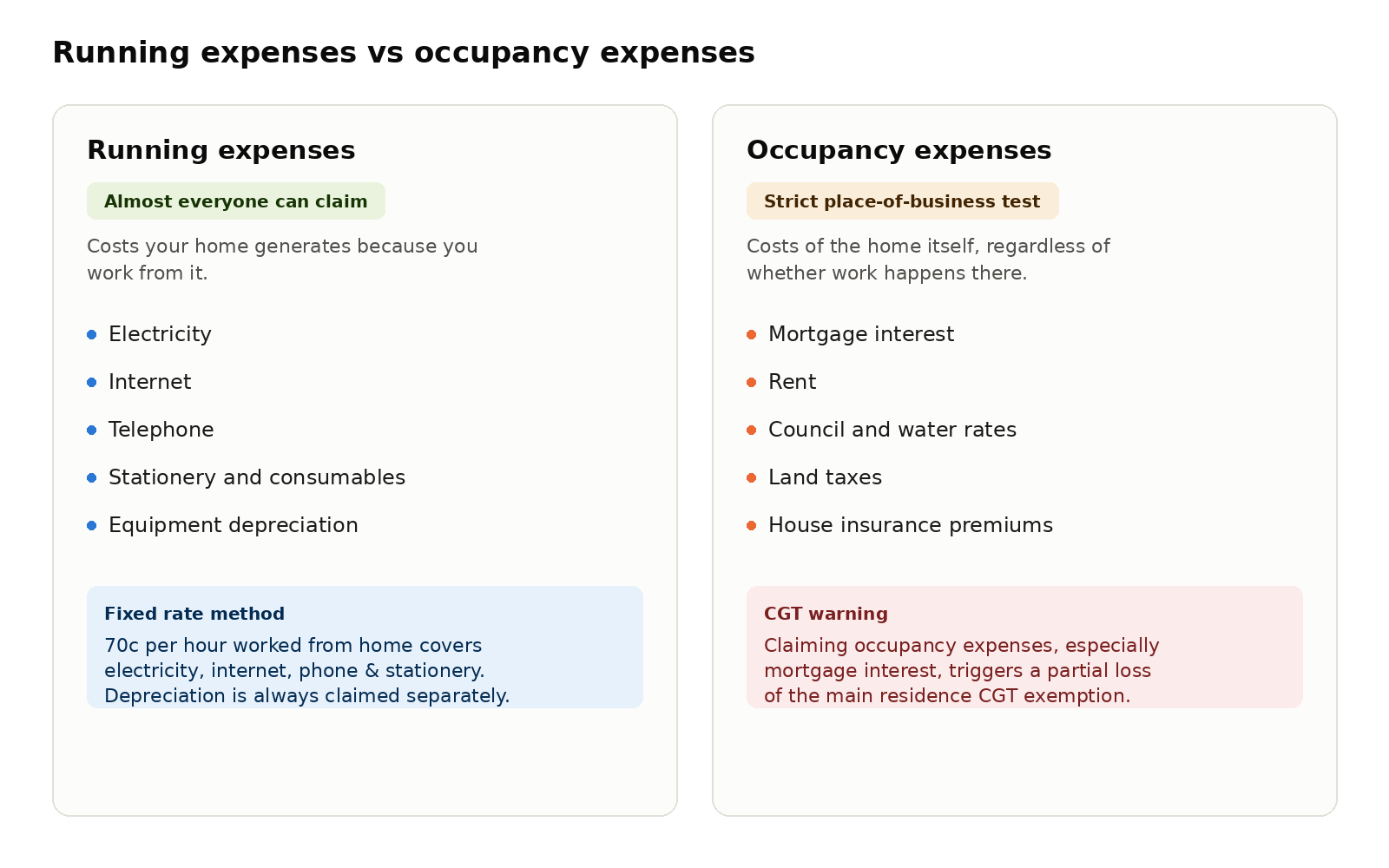
Running expenses are the costs your home generates because you are working from it. Think of it this way: the moment you sit down to work, the electricity meter starts running, your internet connection is being consumed, your phone is being used, your chair is wearing out. These costs are directly tied to the work being done. They would not be incurred to the same extent if you were not working from home.
Almost everyone working from home can claim running expenses. The question is which specific costs apply to your situation.
- Electricity — the power you use to run your computer and light your workspace. You can claim the work-related portion, not the entire bill.
- Internet — deductible to the extent it is used for work. If the same connection is used for personal purposes, only the work-related percentage can be claimed.
- Telephone — work-related calls and the work-related portion of your mobile phone plan are deductible. Where the phone is used for both work and personal purposes, you need to identify the percentage that relates to work.
- Stationery and consumables — printer paper, pens, ink cartridges, and other consumables purchased wholly for work are deductible in full.
- Equipment and furniture — laptops, monitors, printers, desks, and office chairs decline in value over time. You can claim that decline in value as a deduction based on the work-related percentage of use. Items costing $300 or less that are used wholly for work can be written off in full immediately. Items above that threshold are depreciated over their effective life. This is one of the most commonly missed deductions for people working from home.
How to Claim Running Expenses
There are two methods available and you must choose one and apply it for the full year.
The fixed rate method allows you to claim 70 cents per hour (2024–25 financial year) for every hour worked from home. This single rate covers electricity, internet, phone, and stationery. You cannot claim those items separately on top of the fixed rate. Equipment depreciation is always claimed separately regardless of which method you use.
Example: Sarah works from home three days a week, eight hours a day, for 48 weeks of the year. That is 1,152 hours. At 70 cents per hour her fixed rate deduction is $806. She also separately claims $400 in depreciation on her office chair and monitor, bringing her total to $1,206.
The actual cost method allows you to calculate the work-related portion of each expense individually.
This requires more detailed records but can produce a larger deduction where actual costs are significant.
Example: Using the same hours, Sarah calculates her actual costs: internet $1,200 per year at 60% work use equals $720, electricity $2,400 per year with a work-related portion of $480, and phone $1,800 per year at 40% work use equals $720. Her total running expense deduction under the actual cost method is $1,920 plus the $400 depreciation, bringing her total to $2,320.
Substantiation: Whichever method you use, keep records of your actual hours worked from home throughout the year as well as invoices and bills for the expenses you are claiming. Where you are claiming a percentage of an expense, you need a reasonable basis for that percentage. The ATO requires records covering the full income year.
Occupancy Expenses
Occupancy expenses are the costs of the home itself. These exist regardless of whether any work takes place in the home, which is precisely why the rules around claiming them are much stricter.
Occupancy expenses include:
- Mortgage interest
- Rent
- Council and water rates
- Land taxes
- House insurance premiums
When Can You Claim Occupancy Expenses?
The core question is whether part of your home has genuinely become a place of business, not just a place where work happens to occur.
A spare room with a desk does not qualify. What the ATO is looking for is a space that has been set up and dedicated to business use to the point where it could not comfortably or readily be used for anything else. The space should be used exclusively or almost exclusively for work, and ideally clients or customers attend there.
This test is most commonly met by sole traders and small business owners who operate from home and have no other business premises.
Example: A mortgage broker operates her practice from a dedicated room in her home. It contains a client meeting table, dual monitors, a filing cabinet with locked client records, and compliance documentation displayed on the wall. Her business address is registered to her home, clients attend for appointments, and the room serves no personal or domestic purpose. She has no other office. In this situation the room has the character of a place of business and occupancy expenses can be claimed for the portion of the home it represents.
If the same broker worked from a home office that doubled as a spare bedroom when family visited, it would not qualify, because the space remains capable of domestic use.
How Occupancy Expenses Are Calculated
The deductible portion is worked out by measuring the floor area of the dedicated work space as a percentage of the total floor area of the home. That percentage is then applied to the total occupancy expenses for the year.
Example: The mortgage broker’s dedicated office represents 12% of the total floor area of her home.
Her annual occupancy expenses are:
- Mortgage interest: $22,400
- Council and water rates: $3,800
- Home insurance: $1,600
- Total: $27,800
12% of $27,800 = $3,336 deductible for the year.
 The CGT Consequence
This is the part that catches most people off guard, and it is worth understanding before you decide to claim.
Your home is ordinarily exempt from capital gains tax when you sell it. But once you start claiming occupancy expenses, and in particular once mortgage interest is in the mix, you are telling the ATO that part of your home is being used to generate income. That portion of the home loses its CGT exemption for every year it was used that way.
Mortgage interest is typically the largest occupancy expense and the main reason people want to claim.
It is also the expense that makes the CGT consequence most significant. In a rising property market, the capital gain on even a small percentage of a home can be substantial, and the tax on that gain can far outweigh the deductions received along the way.
Common Mistakes
1. Claiming running expenses on top of the fixed rate. The fixed rate of 70 cents per hour is designed to simplify your claim by covering electricity, internet, phone, and stationery in a single hourly rate. Once you choose this method, those costs are already included and you cannot claim them in addition.
2. Using an outdated method. The ATO replaced the 80c per hour shortcut method introduced during COVID. The current rate is 70c per hour.
3. Applying a work percentage that cannot be justified. The percentage you claim for any expense needs to reflect actual work use and be reasonable based on your circumstances.
4. Assuming a home office qualifies for occupancy expenses. Most home offices do not meet the place of business test. Unless the space is genuinely dedicated to business use and could not readily be used for anything else, running expenses are the only available claim.
5. Claiming occupancy expenses without understanding the CGT impact. The short-term saving is often significantly outweighed by the tax cost when the property is eventually sold.
6. Missing equipment depreciation. This sits outside both methods and is a legitimate deduction that is frequently overlooked.
Getting It Right
Home office claims seem simple on the surface but the details matter, particularly once occupancy expenses are involved. If you are a sole trader or small business owner working from home, it is worth reviewing your claims with an accountant to make sure you are claiming everything you are entitled to, applying the right percentages, and not inadvertently creating a tax problem down the track.
This article contains general information only and does not constitute tax advice. Your individual circumstances will determine what you can claim. If you are unsure, speak with a registered tax agent.
About the Author
Andrew Beks is an Australian accountant specialising in tax and accounting for individuals and small businesses. For practical tax guides and small business resources, visit simplifiedbusinessandaccounting.com.au