

For decades, property has been one of Australia’s favourite investment strategies. Many investors have relied on generous tax concessions such as the Capital Gains Tax (CGT) discount, negative gearing, family trust income splitting, and SMSF property investing to build wealth.
But what if those tax advantages were no longer available?
Following the Federal Government’s proposed tax reforms announced in the 2026 Federal Budget, Australia’s investment landscape is changing significantly. These reforms are designed to reduce tax concessions that have traditionally favoured property investors and encourage a greater focus on genuine investment returns rather than tax benefits.
The question every investor should now ask is:
Is your investment strategy ready for the new environment?
In this article, we’ll explore the proposed changes, what they could mean for investors, and where new tax-effective opportunities may emerge.
1. Capital Gains Tax (CGT) Is Changing
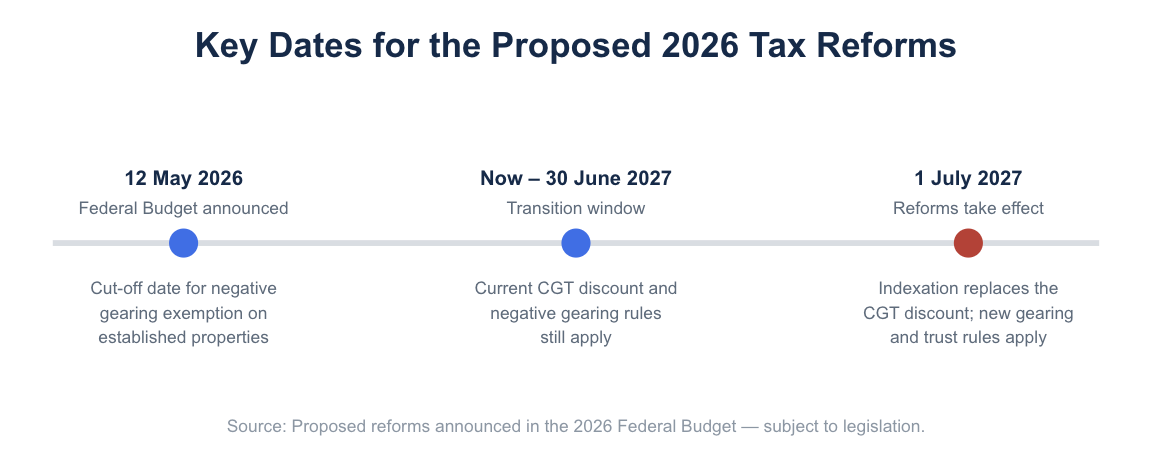
Until 30 June 2027, investors who hold an asset for more than 12 months can still access the 50% Capital Gains Tax discount.
From 1 July 2027, under the proposed reforms, the 50% discount will be replaced with an indexation method, and a minimum effective CGT rate of 30% will apply for many taxpayers.
Example
James purchases an investment property for $800,000 and sells it 18 months later for $1,000,000.
Under the current rules
- Capital gain: $200,000
- 50% CGT discount
- Taxable gain: $100,000
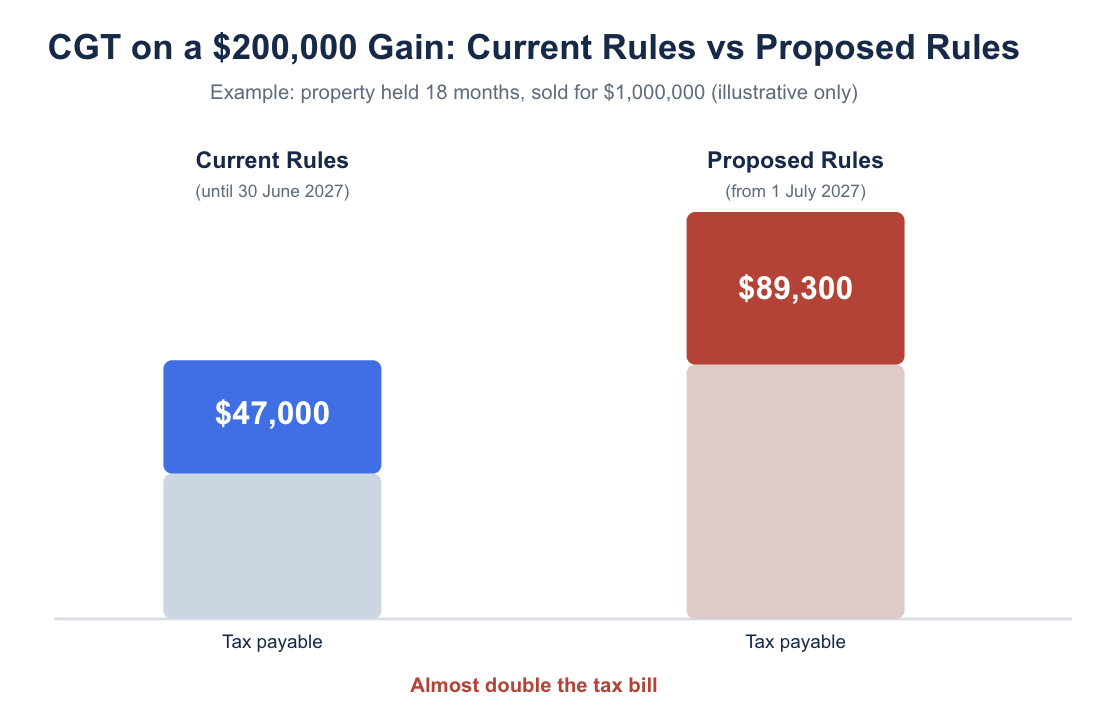
- Tax payable (47% marginal tax rate): $47,000
Under the proposed rules
- No 50% discount
- Assuming 5% inflation over the holding period, indexation reduces the taxable gain by approximately $10,000
- Taxable gain: $190,000
- Tax payable: $89,300
Result: The tax bill is almost double.
For investors who buy and sell property within relatively short periods, this change could substantially reduce after-tax returns.
Not sure how the CGT changes affect your existing or planned property investments?
Book a free discovery call with Compound Freedom and let’s review your strategy before the rules change.
2. Negative Gearing Is Being Limited
Another major reform affects negative gearing.
Current rules (until 30 June 2027)
Rental losses can generally be deducted against other taxable income, such as salary or business income.
Proposed rules (from 1 July 2027)
For established residential properties purchased after 12 May 2026, rental losses will no longer be able to reduce other assessable income.
Instead:
- losses can be offset against future rental income
- losses may be used to reduce future capital gains
- unused losses can be carried forward.
Important exceptions
The proposed changes do not apply to:
- established properties purchased before 12 May 2026
- eligible newly constructed residential properties.
This means investors can no longer rely on tax refunds to support a cash-flow-negative investment. Future property investments will need to stand on their own financial merits.
3. SMSF Residential Property Investing Is Tightening
Self-managed super funds (SMSFs) have long been used to purchase residential investment properties with borrowed money.
Under the proposed reforms, SMSFs’ borrowing will generally be restricted from acquiring residential property unless it qualifies as business real property.
This means:
- reduced flexibility for SMSF property investors
- greater emphasis on diversified investment portfolios inside super
- more focus on professionally managed investment options.
4. Family Trust Tax Changes
Family trusts have traditionally allowed income to be distributed among family members in lower tax brackets.
The proposed reforms introduce a minimum effective tax rate of 30% on trust distributions.
As a result:
- income splitting opportunities will be significantly reduced
- tax planning through discretionary trusts becomes less effective for many families.
The Bigger Picture
Taken together, these reforms represent a major shift in Australia’s investment landscape.
The old approach
- Buy property primarily for tax benefits.
- Use trusts to minimise tax through income splitting.
The new reality
Property investments will increasingly need to generate strong underlying investment returns rather than relying on tax concessions.
There Are Still Opportunities
Although the reforms reduce several long-standing tax benefits, they also create opportunities for investors who adapt.
Indexation may benefit long-term investors
For assets held over many years, inflation indexation may produce a larger adjustment than expected, particularly during periods of higher inflation.
Negative gearing is not disappearing entirely
Rental losses can still provide value by reducing future rental income or capital gains.
Some investors remain protected
Certain investors are unaffected or only partially affected by the reforms, including:
- owners of established properties purchased before 12 May 2026
- eligible purchasers of new residential developments
- individuals receiving income support, such as the Age Pension, who are not expected to be subject to the proposed minimum 30% CGT rate.
Where Are the New Opportunities?
As traditional property tax advantages become less attractive, many investors are looking towards investment structures that offer greater long-term tax certainty.
Two areas deserve particular attention:
- Superannuation
- Insurance bonds
These strategies can provide:
- greater tax efficiency
- long-term certainty
- more predictable after-tax outcomes.
Case Study 1: Superannuation
David, aged 50, contributes $400,000 into superannuation.
During the accumulation phase:
- Investment return (8%): $32,000
- Tax inside super (15%): $3,600
- Net investment earnings: $28,400
After retirement, once David commences a retirement income stream after age 60:
- Annual investment earnings: $32,000
- Tax payable: $0
Superannuation becomes a highly tax-effective environment in retirement, making it an increasingly valuable wealth-building strategy under the proposed rules.
Case Study 2: Insurance Bonds
Emma, aged 35, is a high-income professional.
She invests $200,000 into an insurance bond.
After ten years, the investment grows to $500,000.
During the investment period:
- earnings are taxed internally (generally up to 30%)
- Emma does not include annual earnings in her personal tax return.
After ten years:
- withdrawals are tax-free
- there is no Capital Gains Tax on the $300,000 growth
- no additional personal tax applies.
If Emma had invested personally, her investment income could have been taxed at up to 45%, while future capital gains may also be taxed under the proposed new CGT rules.
Insurance bonds can therefore offer simplicity, tax certainty, and attractive long-term outcomes for suitable investors.
Wondering whether superannuation or an insurance bond suits your situation better?
Every investor’s circumstances are different. Book a call with Compound Freedom to work out which tax-effective structure fits your goals.
The New Investment Playbook
The investment landscape is changing.
The old strategy relied heavily on property tax concessions and trust structures.
The new strategy focuses on:
- understanding the changing tax rules
- using appropriate investment structures
- building long-term, tax-efficient wealth.
For many Australians, this means giving greater consideration to strategies such as:
- superannuation, where retirement income can be tax-free in the pension phase
- insurance bonds, which can provide tax-free withdrawals after ten years when legislative requirements are met.
Final Thoughts
Tax laws evolve, but successful investors evolve with them.
While property will continue to play an important role for many Australians, future investment decisions should be based on strong fundamentals rather than tax concessions alone.
By understanding the proposed reforms and reviewing your investment strategy early, you can position yourself to take advantage of the opportunities that still exist.
The rules may be changing, but with the right advice and a well-structured plan, you can continue building wealth with confidence.